Accessibility Is Becoming Law: What It Means for Your 360° Content
Accessibility rules like Section 508, the ADA, Section 504, and the European Accessibility Act increasingly require digital content to meet WCAG standards, and that reach now extends to interactive 360° experiences. In practice it means your tours need a genuine screen-reader and keyboard path, not just alt text on a thumbnail.
For a long time, accessibility was treated as a nice-to-have, the thing you would get to after launch if a customer or an auditor ever asked. That era is ending.
Across the United States and beyond, accessible digital content is becoming a legal requirement rather than a courtesy. And for interactive 360° content, which is visual and spatial by its very nature, that raises a fair question: how do you make an experience built around looking around usable by someone who cannot see it?
It is a question we have spent years answering. Think of this as a companion to our full accessibility policy and conformance report, focused on why the topic matters more than ever right now, and what it means for you.
Accessibility Is Becoming Law
If your organization works with government, education, or healthcare, or operates in the EU, accessible digital content is increasingly required by law. A few of the frameworks driving that shift:
Section 508 of the Rehabilitation Act (United States)
Section 508 requires that information and communication technology (ICT) used by U.S. federal agencies be accessible to people with disabilities. The standard was significantly modernized to bring it in line with the WCAG guidelines:
Section508.gov, U.S. General Services AdministrationOn January 18, 2017, the U.S. Access Board published a final rule updating accessibility requirements for information and communication technology (ICT) covered by Section 508 of the Rehabilitation Act and Section 255 of the Communications Act. The U.S. General Services Administration (GSA) Office of Government-wide Policy (OGP) is tasked under this law to provide technical assistance to help Federal agencies comply with these requirements, and ensure that covered ICT is accessible to, and usable by, individuals with disabilities.
In practice, that means any federal agency, and any vendor that sells to one, needs digital content, including virtual tours and interactive media, that meets the Revised Section 508 standards. You can read the requirements in full at Section508.gov.
The Americans with Disabilities Act (ADA)
The ADA's accessibility expectations now extend clearly to the digital world. Under Title II (state and local government) and Title III (public accommodations), organizations are expected to make their websites and digital experiences accessible, with WCAG Level AA as the widely accepted benchmark. For schools, universities, and public bodies, that increasingly includes the interactive content they publish. You can learn more at ADA.gov.
Section 504, and the Rest of the World
Section 504 of the Rehabilitation Act extends similar obligations to any organization that receives federal funding. Outside the U.S., the European Accessibility Act has required accessible digital products and services across the EU since June 2025, built on the EN 301 549 standard. The direction of travel is the same everywhere: accessible by default, backed by the WCAG guidelines from the W3C.
Why 360° Content Is Harder to Make Accessible
Most accessibility guidance assumes a fairly flat, text-and-image web page. A 360° experience is a different animal. The content is visual and spatial, the navigation is interactive, and key information is often tucked inside hotspots a viewer has to find and click. For someone using a screen reader, a keyboard, or an adaptive controller, a poorly built 360° tour can be a dead end.
That is the exact problem we set out to solve, and it is where SeekBeak has invested far more than most.
How SeekBeak Leads on Accessible 360° Content
SeekBeak is a no-code, browser-based platform for interactive 360° tours, 3D models, and immersive experiences, and accessibility has been a core priority since we started in 2014. By any practical measure, it is one of the most accessible interactive 360° platforms available, and a few things set our approach apart:
- A published VPAT. SeekBeak is one of the only virtual tour platforms to publish a full Voluntary Product Accessibility Template, the document procurement teams use to verify compliance. Our Accessibility Conformance Report covers WCAG 2.0, 2.1, and 2.2 (Level A and AA), Revised Section 508, and the EU's EN 301 549 in a single international edition.
- An Accessible Text Viewer. This automatically generates a screen-reader-friendly text version of any 360° image, flat image, 3D model, or Gaussian Splat, pulling out every hotspot, title, description, link, and embed. There is no second version to build and nothing to fall out of date.
- Full keyboard and assistive-technology support. Every viewer function works by keyboard, with screen-reader compatibility (VoiceOver, NVDA, Narrator, ChromeVox, and TalkBack) and support for gamepads and the Xbox Adaptive Controller.
- Independent verification. We work with CAST.org, a global leader in inclusive education, and outside specialists to confirm our viewers meet or exceed the standards we claim.
The full technical detail, including the downloadable conformance report and a complete keyboard reference, lives on our accessibility page.
Text Viewer Comparison
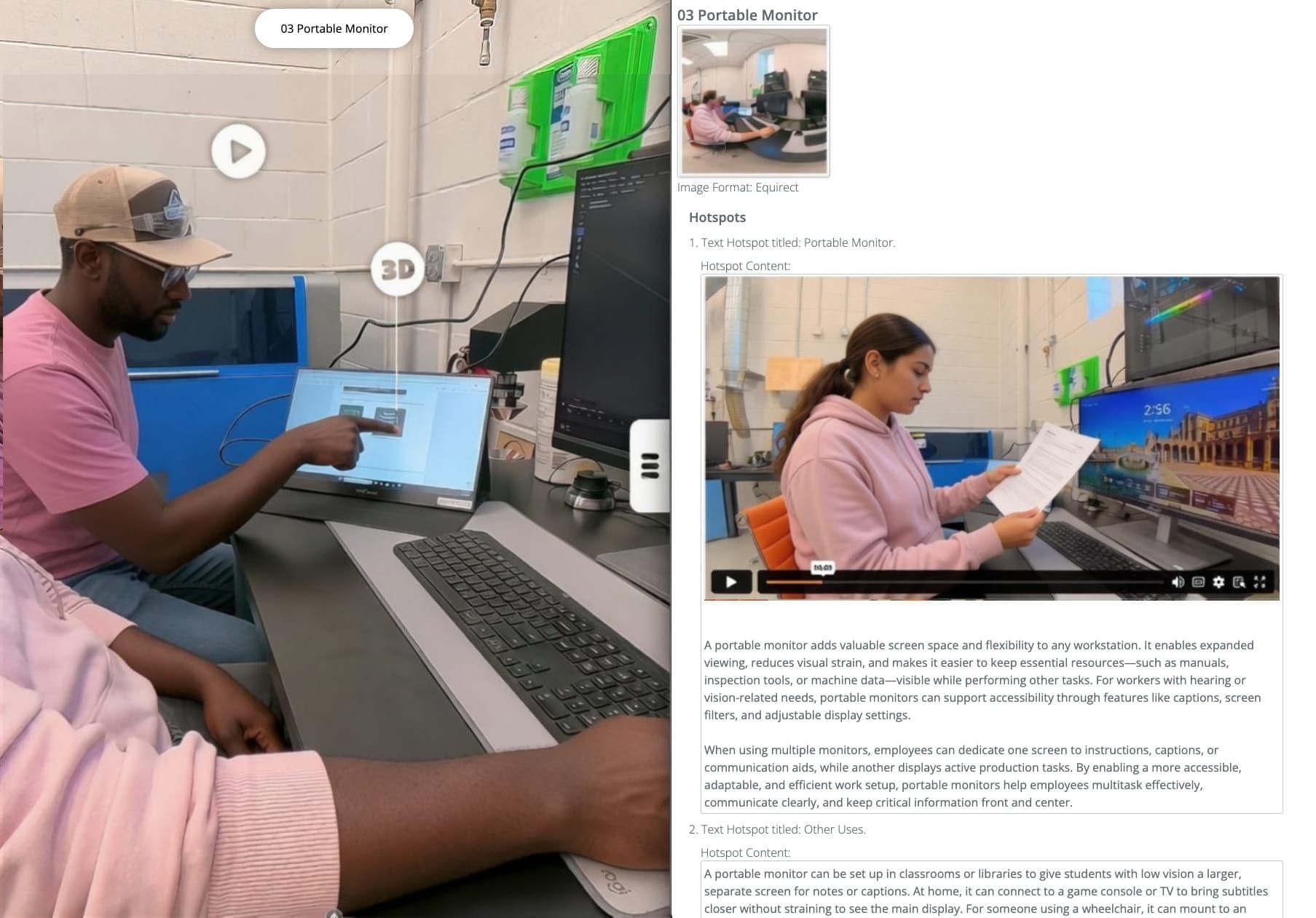
A side by side comparison of the original 360º Snap on the left, and the dynamically generated text viewer on the right.
Recognition Beyond Our Own Claims
It is one thing for a company to say it takes accessibility seriously. It means more when others say it too. SeekBeak's work on inclusive immersive content is the subject of a forthcoming 2026 article, “Making 360° Content More Inclusive,” in the Journal of Advanced Technological Education. We are proud that the way we approach accessible 360° experiences is being recognized as an approach worth studying, not just marketing.
What This Means for You
If you publish interactive or 360° content, here is how to stay on the right side of these requirements:
- Ask for a VPAT. When you evaluate any platform, request its Accessibility Conformance Report. If a vendor cannot produce one, treat that as a red flag for any regulated deployment.
- Insist on a real accessible alternative. Visual and spatial content needs a genuine text-based, screen-reader-friendly path, not just alt text on a thumbnail.
- Build it in from the start. Retrofitting accessibility after the fact is painful and expensive. Choosing a platform that is accessible by default means compliance is largely handled before you ever publish.
This matters most for education and training, government, and healthcare, where accessible content is both a legal obligation and simply the right thing to do.
Key Takeaways
- Accessibility for digital content is shifting from optional to legally required, driven by Section 508, the ADA, Section 504, and the European Accessibility Act.
- 360° content is uniquely hard to make accessible because it is visual, spatial, and interactive.
- SeekBeak is one of the few virtual tour platforms with a published VPAT and an automatic Accessible Text Viewer, meeting WCAG 2.2 AA, Section 508, and EN 301 549.
- SeekBeak's inclusive approach is the subject of a forthcoming 2026 article in the Journal of Advanced Technological Education.
- When choosing a platform, ask for a VPAT, insist on a real accessible alternative, and build accessibility in from day one.
Frequently Asked Questions
Increasingly, yes. Section 508 requires digital content used by U.S. federal agencies, and the vendors that sell to them, to be accessible, while the ADA's expectations under Titles II and III extend to websites and digital experiences, with WCAG Level AA as the widely accepted benchmark. For schools, government bodies, and public accommodations, that increasingly includes the interactive and 360° content they publish.
A VPAT (Voluntary Product Accessibility Template) is the document procurement teams use to verify a product's accessibility, published as an Accessibility Conformance Report. If a vendor cannot produce one, treat that as a red flag for any regulated deployment. SeekBeak publishes a full VPAT covering WCAG 2.0, 2.1, and 2.2 (Level A and AA), Revised Section 508, and the EU's EN 301 549.
The content needs a genuine text-based, screen-reader-friendly path, not just alt text on a thumbnail, plus full keyboard operation of every viewer function. SeekBeak's Accessible Text Viewer automatically generates a screen-reader-friendly text version of any 360° image, flat image, 3D model, or Gaussian Splat, pulling out every hotspot, title, description, and link. Its viewers also support screen readers like VoiceOver, NVDA, and TalkBack, plus gamepads and the Xbox Adaptive Controller.
If you offer digital products or services in the EU, it likely does. The European Accessibility Act requires accessible digital products and services across the EU, built on the EN 301 549 standard, which aligns closely with the WCAG guidelines. The safest approach is to choose content and platforms that meet WCAG Level AA by default.
Build 360° Content Everyone Can Use
See the standards we meet and download our Accessibility Conformance Report, or start building accessible interactive content for free.